Transcript
Announcer:
You’re listening to Eye on Ocular Health on ReachMD, and this episode is sponsored by Apellis Pharmaceuticals Inc. Here’s your host, Dr. Brian McDonough.
Dr. McDonough:
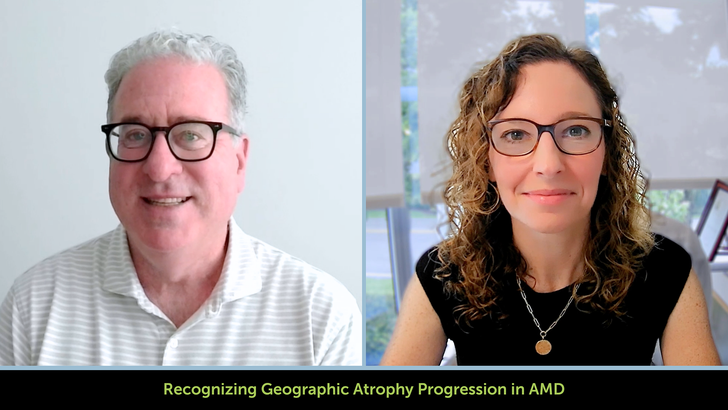
Welcome to Eye on Ocular Health on ReachMD. I'm Dr. Brian McDonough, and today, we'll be discussing the progression from age-related macular degeneration, or AMD, to geographic atrophy and why earlier recognition has become increasingly important for these patients. Joining me in this conversation is Dr. Jaclyn Kovach, who's a Professor of Clinical Ophthalmology and the Fellowship Director at the University of Miami Miller School of Medicine's Bascom Palmer Eye Institute. Dr. Kovach, we're so glad to have you here today
Dr. Kovach:
It's such a pleasure to be here with you today.
Dr. McDonough:
To begin, Dr. Kovach, can you give us a little background on geographic atrophy and why it's such a significant clinical and public health burden?
Dr. Kovach:
Of course. So geographic atrophy is a form of advanced dry age-related macular degeneration, and it's estimated that it affects about 1.5 million people in the United States. But I think that's really an underestimation. I think there are many folks over the age of 50 who are walking around with earlier stages of macular degeneration who haven't been diagnosed. So it is an important health problem in our country.
Dr. McDonough:
So when you think about patients with intermediate AMD, what clinical findings or symptoms raise concern that it may be progressing toward geographic atrophy?
Dr. Kovach:
Right. So we are in need of more biomarkers—things that tell us which patients are more likely to progress more quickly and which patients we need to consider treating. So we do have some biomarkers on our various imaging modalities. On OCT, we look for drusen volume, hyperreflective intraretinal foci, and RPE changes. On fundus autofluorescence, we look for certain hyperautofluorescence patterns, and those will point us to identify those at high risk of rapid progression.
Dr. McDonough:
With that being said, what do we currently understand about the biologic mechanisms that contribute to geographic atrophy progression, especially regarding the role of complement dysregulation?
Dr. Kovach:
So unregulated inflammation is really a driver of the development and progression of age-related macular degeneration. AMD is also a hereditary disease. We've identified over 50 genetic polymorphisms that modulate AMD risk. Many of those are involved in the complement cascade. And we have two new medications for geographic atrophy that target the complement pathway.
Dr. McDonough:
For those just tuning in, you're listening to Eye on Ocular Health on ReachMD. I'm Dr. Brian McDonough, and I'm speaking with Dr. Jaclyn Kovach about our evolving understanding of geographic atrophy and the importance of recognizing progression early.
Now, geographic atrophy can affect patients well beyond traditional visual acuity measurements. Knowing that, Dr. Kovach, how do you discuss the functional and quality-of-life impact of this condition with patients and caregivers?
Dr. Kovach:
Right. So every patient that comes into our eye clinic gets a Snellen best-corrected visual acuity evaluation, which is really an inadequate way to assess the visual function of our GA patients because patients can have good central vision or 20/20 vision but also have geographic atrophy that's affecting a good portion of the macula not involving the fovea. That can really hinder their ability to drive, read, recognize faces, and do the normal activities that they need and want to do.
It can also be very socially isolating. I have patients tell me that someone waved to them from a distance. They didn't know who it was; they didn't know if they should wave back. So that compounds the anxiety, depression, and social isolation that our patients can experience.
Dr. McDonough:
We also now recognize that geographic atrophy and neovascular AMD can coexist in the same eye. How has that changed the way we think about AMD as a disease spectrum?
Dr. Kovach:
So many of my patients do have geographic atrophy and wet AMD in the same eye, and they're getting treated for both conditions simultaneously. And really, geographic atrophy and wet AMD are both advanced forms of the disease.
In geographic atrophy, you get the degeneration of photoreceptors, their underlying support cells—RPE cells—and vascular support, or the choriocapillaris. So it's a gradual, relatively slow degenerative process that happens in the central macula. In contrast with wet macular degeneration, you get the proliferation of new blood vessels that leak and bleed under the retina. So you can see how both of those processes can occur concurrently in the same eye.
Dr. McDonough:
This is such a complex process, and I know there's a great deal of research being done. What are some new treatments on the horizon?
Dr. Kovach:
So back in 2023, two new medications for geographic atrophy were FDA approved, and these are really the first medications that we've ever had other than vitamin supplementation to treat our patients with GA. These medications are injected into the eye about every two months long term, and they've been proven in clinical trials to reduce the progression of geographic atrophy by about 20 or 30 percent.
And patients, in general, are tolerating these medications quite well. You know, we do these injections all day long for geographic atrophy and for wet age-related macular degeneration. Obviously, we want the patient to be as comfortable as possible. And so the process of getting the patient ready for these injections includes cleaning the eye and putting numbing drops in the eye. And the injection just takes a few seconds. So these patients tolerate this very well.
It's always important to explain the expectations of what these drugs can do. They don't halt the disease. They don't improve the vision. But they do slow the progression. And then patients are really doing everything they possibly can for their condition.
Dr. McDonough:
Before we wrap up, Dr. Kovach, what do you think is most important for our audience to know when it comes to recognizing progression risk and monitoring patients over time?
Dr. Kovach:
Right. So I think it's really important for ophthalmologists and optometrists to be able to identify geographic atrophy early so they can potentially benefit as much as possible from our newer treatments. Multimodal imaging is really critical in making that diagnosis. Fundus photos, fundus autofluorescence, and OCT imaging are things that should be done regularly on all of the AMD patients that we see.
Dr. McDonough:
With those final thoughts in mind, I want to thank my guest, Dr. Jaclyn Kovach, for joining me to explore how patients with intermediate AMD may progress to geographic atrophy and what we should watch for along the way. Dr. Kovach, it was great having you on the program.
Dr. Kovach:
Thank you so much. A pleasure to be here.
Announcer:
You’ve been listening to Eye on Ocular Health, and this episode was sponsored by Apellis Pharmaceuticals Incorporated. To access this and other episodes in our series, visit Eye on Ocular Health on ReachMD.com, where you can Be Part of the Knowledge. Thanks for listening!